IPL Treatment for Dry Eyes in Miami: Does It Really Work?
By Dr. Antoine Copty, Eyes On Brickell — Brickell, Miami, FL
If artificial tears, warm compresses, and eyelid wipes have stopped making a real difference, you’re not imagining it, and you’re not out of options. Intense Pulsed Light (IPL) treatment is one of the most effective tools available today for chronic dry eye caused by Meibomian Gland Dysfunction (MGD), and at Eyes On Brickell, it’s a treatment we perform regularly for patients across Brickell, Downtown Miami, and greater South Florida.
This guide covers exactly what IPL treatment is, how it works, what the research actually shows, what a session feels like, how much it costs, and how it compares to alternatives like LipiFlow, so you can walk into your consultation already informed.
What Is IPL Treatment?
IPL (Intense Pulsed Light) treatment is a non-invasive, in-office procedure that uses controlled pulses of broad-spectrum light to reduce inflammation around the eyelids and restore normal function to the meibomian glands, the tiny oil glands responsible for keeping tears from evaporating too quickly.
Unlike a laser, which emits a single, focused wavelength, IPL delivers a broader spectrum of light, which is why “laser dry eye treatment” is a common but inaccurate way patients describe it.
IPL was originally developed for dermatology, treating rosacea, broken capillaries, and skin pigmentation. Eye care doctors noticed something important: patients being treated for facial rosacea with IPL were also reporting major improvements in their dry eye symptoms.
That observation led to IPL becoming an FDA-cleared option (via devices such as Lumenis OptiLight) specifically for dry eye disease associated with MGD.
Why Dry Eye Happens: MGD, Rosacea & Inflammation
Most chronic dry eye isn’t caused by too little tear volume, it’s caused by poor tear quality. Here’s the chain of events:
- Your eyelids contain meibomian glands, which produce an oily substance called meibum. This oil forms the outer layer of your tear film and prevents your tears from evaporating.
- When these glands become blocked, inflamed, or damaged, a condition called Meibomian Gland Dysfunction (MGD), oil output drops or becomes thick and waxy instead of clear.
- Without that protective oil layer, tears evaporate too fast, leading to burning, grittiness, redness, light sensitivity, and blurry vision that fluctuates through the day.
- Ocular rosacea is closely linked to this problem: research shows that roughly 80% of people with rosacea also have some degree of MGD, because the same chronic inflammation affecting facial skin also affects the eyelid margin and glands.
This is why symptom-only treatments, drops, warm compresses, lid wipes, often provide temporary relief without solving the underlying problem.
IPL is different because it targets the inflammation and abnormal blood vessels feeding that inflammation, not just the symptoms sitting on top of it.
How IPL Actually Works
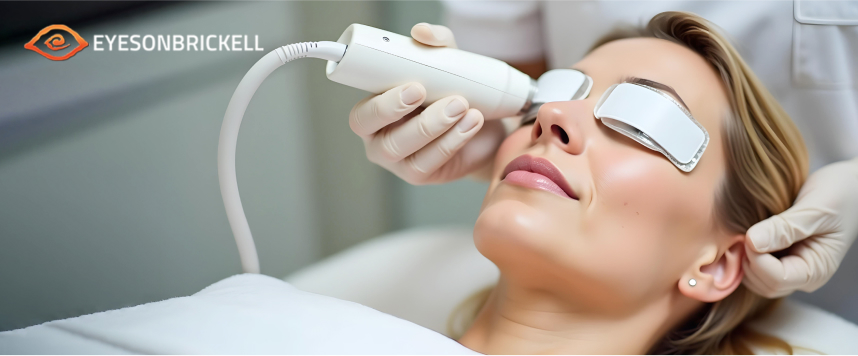
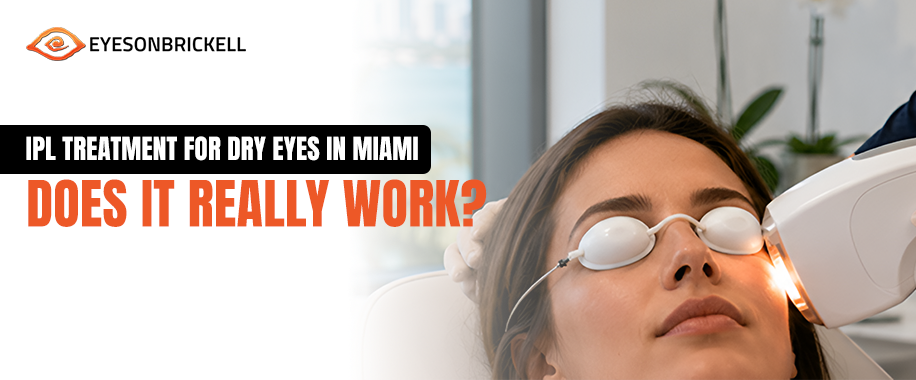
During treatment, a handheld device delivers gentle pulses of light to the skin just below the lower eyelids and along the upper cheek. This light is absorbed by abnormal, dilated blood vessels in the skin, causing them to close off.
Since these vessels are what feed chronic inflammation to the eyelid margin and meibomian glands, closing them:
- Reduces ongoing inflammation at the source.
- Allows the meibomian glands to recover normal function over time.
- Improves meibum quality, from thick and toothpaste-like to thinner and clearer.
- Often reduces populations of Demodex mites and bacteria that thrive in inflamed, oil-clogged glands.
Most IPL protocols also include manual meibomian gland expression (MGX) immediately after the light treatment, gently clearing out the softened, improved oil so the glands can start producing fresh, healthy meibum.
Does IPL Really Work? What the Research Shows
This isn’t a fringe or purely cosmetic idea, it’s supported by a growing body of published clinical research:
- A large case series of 390 eyes found significant improvements in tear film osmolarity and meibum quality after four IPL sessions, with better secretions (clearer, less waxy) observed in the majority of patients.
- A randomized trial concluded that IPL was more effective than traditional eyelid massage combined with warm compresses for MGD-related dry eye, with a strong safety profile.
- Multiple studies combining IPL with meibomian gland expression have shown measurable improvements in tear breakup time, lipid layer thickness, and validated symptom scores like the OSDI (Ocular Surface Disease Index) questionnaire.
In plain terms: across multiple independent studies, patients who complete a full IPL series show meaningful, measurable improvement in both objective eye tests and how their eyes actually feel, not just a placebo effect.
That said, IPL is a management tool, not an instant permanent cure. Most patients experience noticeable relief within one to two sessions, with results building through a full series and typically lasting several months to about a year before a maintenance treatment is needed.
Am I a Candidate for the IPL?
IPL tends to work best for patients with:
- Evaporative dry eye linked to MGD.
- Ocular rosacea or visible redness/flushing around the eyes.
- Dry eye that hasn’t responded well to drops, compresses, or lid hygiene alone.
- Contact lens discomfort caused by an unstable tear film.
- Screen-related dry eye that worsens through the workday.
IPL Treatment is not typically recommended for patients who are pregnant, have very dark skin tones (Fitzpatrick V–VI, due to higher pigment absorption, your doctor will assess this individually), have active skin infections or recent significant sun tanning in the treatment area, or are on certain photosensitizing medications.
A comprehensive dry eye evaluation at Eyes On Brickell, including a review of your meibomian gland structure, will confirm whether IPL is the right fit before we recommend it.
What to Expect During Treatment
- Protective eyewear is placed over your eyes for safety.
- A cool ultrasound-style gel is applied to the treatment area (under-eye and upper cheek).
- The IPL device delivers a series of gentle light pulses. Most patients describe this as a warm snap, similar to a light rubber-band flick, mild, brief, and well tolerated without numbing drops in most cases.
- Immediately afterward, we perform manual meibomian gland expression to clear softened, improved oil from the glands.
- The entire visit typically takes 15–30 minutes.
There’s no downtime, you can resume your normal day immediately, including work, driving, and screen use.
Recovery, Side Effects & Safety
IPL for dry eye has a strong safety record when performed by a trained provider using an FDA-cleared device with proper eye protection. Reported side effects are generally mild and temporary:
- Slight redness or warmth in the treated skin for a few hours.
- Mild swelling in sensitive patients.
- Rarely: temporary discoloration or blistering if skin sensitivity wasn’t properly assessed beforehand.
Serious complications are uncommon when protective eyewear is used correctly and candidacy is properly screened, which is exactly why the initial evaluation matters as much as the treatment itself.
How Many Sessions Will I Need?
Most patients complete a series of four sessions, spaced roughly three to four weeks apart, this spacing matches the natural renewal cycle of the treated blood vessels and meibomian glands. Many patients start noticing symptom improvement after session one or two, with cumulative benefit through the full series.
After the initial series, results commonly last six months to a year, at which point a single maintenance session can sustain the improvement, similar to how routine dental cleanings maintain (rather than one-time fix) oral health.
IPL vs. LipiFlow vs. Drops: Which Is Right for You?
Compare IPL, LipiFlow, and eye drops to understand how each treatment works and which option may provide the most effective relief for your dry eye symptoms.
| Treatment | How It Works | Sessions | Best For |
|---|---|---|---|
| IPL (Intense Pulsed Light) | Light pulses reduce inflammation and abnormal blood vessels around the glands. | Series of ~4 sessions, then maintenance treatments as needed. | MGD linked to rosacea/inflammation; broader root-cause treatment. |
| LipiFlow | Applies localized heat and gentle pressure directly to the eyelids to clear gland blockages. | Typically 1 session, repeated every 6–12 months if needed. | Mechanical gland blockage without significant surface inflammation. |
| Warm Compresses / Lid Hygiene | At-home heat and eyelid cleaning help loosen gland oils and remove debris. | Daily, ongoing. | Mild cases and maintenance between in-office treatments. |
| Artificial Tears / Prescription Drops | Supplement or stimulate tear production and improve tear quality. | Ongoing daily use. | Symptom relief; often paired with IPL rather than replacing it. |
Many patients get their best long-term results by combining approaches, for example, IPL to address inflammation at the source, plus at-home lid hygiene to maintain gains between visits. We’ll help you decide what combination fits your specific diagnosis.
Cost of IPL Treatment
IPL for dry eye is generally billed as a cosmetic/elective procedure and is not typically covered by standard vision or medical insurance, though many patients use HSA or FSA funds to help offset the cost. Pricing varies by clinic and geography, and typically reflects a per-session or per-series rate rather than a single flat fee.
During your consultation at Eyes On Brickell, we’ll give you a clear, itemized quote for a full series based on your specific evaluation, no guessing, no surprise charges.
Common Myths About IPL
- “IPL is a laser.” IPL uses a broad spectrum of light, not a single focused laser wavelength, which is part of why it’s safer for the delicate skin around the eyes.
- “One session fixes it permanently.” IPL is highly effective, but it’s a management therapy with a typical 4-session series and periodic maintenance, not a one-time cure.
- “It’s purely cosmetic.” While IPL is also used cosmetically for skin, its use for dry eye targets a specific medical mechanism (inflammation and abnormal blood vessels feeding MGD) supported by published clinical research.
- “Only fair-skinned patients can get it.” Candidacy depends on your Fitzpatrick skin type and individual evaluation, many skin tones are appropriate candidates; your doctor will confirm this at your visit.
Ready to Stop Managing Dry Eye and Start Treating It?
If you’ve tried drops, compresses, and lid wipes without lasting relief, it may be time to address the root cause. Dr. Antoine Copty and the team at Eyes On Brickell offer comprehensive dry eye evaluations and IPL treatment right in the heart of Brickell, Miami.
Visit us at: 2885 SW 3rd Ave Suite 100, Miami FL 33129
Frequently Asked Questions
1. Is IPL treatment painful?
Most patients describe it as a brief warm snap against the skin, comparable to a light rubber-band flick, mild and well tolerated without numbing drops for most people.
2. How soon will I notice the results?
Many patients notice improvement after their first or second session, with full benefit typically developing across the complete four-session series.
3. How long does IPL relief last?
Results commonly last six months to about a year, at which point a single maintenance session can sustain your improvement.
4. Does IPL damage the eyes?
No, when performed correctly with proper protective eyewear by a trained provider. Risk mainly relates to skin around the eyes, not the eye itself, and serious side effects are uncommon.
5. Is IPL covered by insurance?
Typically no, it’s usually classified as an elective procedure, though HSA/FSA funds are commonly used to help cover the cost. We’ll confirm current pricing and payment options at your consultation.
6. What’s the difference between IPL and LipiFlow?
IPL treats inflammation and abnormal blood vessels around the glands using light pulses; LipiFlow applies direct heat and pressure to the eyelids to physically clear blocked glands. Some patients benefit from one, the other, or a combination, we’ll help determine which fits your diagnosis.
7. Can IPL help if I already use eye drops daily?
Yes, many patients continue using drops between IPL sessions, especially early in treatment, and are often able to reduce their reliance on drops as gland function improves.
8. Do I need a referral to book an IPL consultation in Brickell?
No referral is required. You can schedule a comprehensive dry eye evaluation directly with Dr. Antoine Copty at Eyes On Brickell to determine whether IPL is right for you.