Scleral Lenses Demand Is on the Rise. Are They Worth the Cost?
Scleral lenses are no longer a little-known option reserved for the most complex eye conditions. Interest among eye-care professionals continues to grow, with the latest 2025 practitioner data showing that 58% of respondents identified scleral lenses as the specialty contact lens with the greatest growth potential for 2026. Scleral lenses accounted for 26% of contact lenses made with rigid GP materials in 2025, up from 21% in 2024.
But growing interest doesn’t necessarily mean they are right for everyone.
Unlike conventional contacts, scleral contact lenses are custom-fitted to the individual eye and are often used when standard lenses cannot provide adequate vision or comfort. That specialized fitting process can also make them considerably more expensive.
So, if you’re researching scleral lenses near me, you may be wondering: Are they really worth the investment?
For someone with keratoconus, an irregular cornea, severe dry eye, or difficulty tolerating traditional contacts, the answer could be very different than it is for someone with routine vision correction needs. Here’s what the latest numbers, clinical evidence, and real-world considerations tell us about the value of scleral lenses, and what you should know before paying for a fitting.
Why Are Scleral Lenses Gaining Attention in 2026?
The growing interest in scleral lenses isn’t simply about more people wanting an alternative to regular contact lenses. The bigger story is that eye-care professionals are increasingly turning to them for patients whose vision or comfort needs are more difficult to address.
The latest 2025 prescribing data gives us a useful snapshot of where the category stands today. Scleral lenses accounted for 26% of rigid gas-permeable (GP) lens fits in 2025, compared with 21% in 2024. Even more telling, 58% of practitioners surveyed identified scleral lenses as the specialty contact lens with the greatest growth potential for 2026.
Why does that matter?
Because scleral lenses are primarily being used to solve problems that conventional contact lenses may struggle with.
They Are Designed for More Complex Eyes
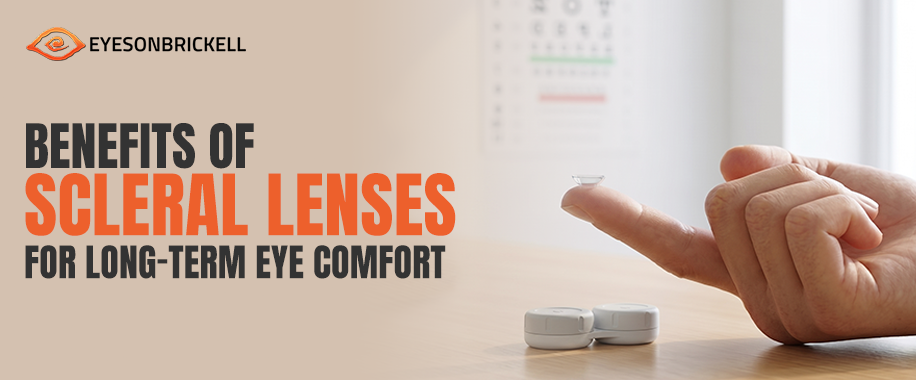
Unlike a typical soft contact lens that sits directly on the cornea, a scleral contact lens is larger in diameter and vaults over the cornea, landing on the sclera. A fluid reservoir is maintained between the lens and the corneal surface.
That design makes scleral lenses particularly useful for eyes with an irregular corneal shape.
Patients with keratoconus, corneal ectasia, corneal scarring, post-surgical irregularities, and certain ocular-surface conditions may be considered for this type of specialty lens.
Keratoconus Is a Major Reason for Specialty Fitting
Keratoconus is one of the conditions most closely associated with scleral lenses for keratoconus.
As the cornea becomes progressively thinner and more cone-shaped, its irregular surface can make it difficult for glasses or conventional soft contacts to provide consistently clear vision. A properly fitted scleral lens can vault over the irregular cornea and create a smoother optical surface.
That doesn’t mean scleral lenses treat or stop keratoconus from progressing. Rather, they can be used as a vision-correction option for appropriate patients.
Comfort Is Another Part of the Equation
Vision isn’t the only reason patients explore scleral lenses.
Some people with significant dry eye or ocular-surface problems find conventional contacts difficult to tolerate. Because scleral lenses maintain a fluid reservoir over the cornea, they may be considered for certain patients with ocular-surface disease.
This is one reason the decision shouldn’t come down to lens price alone.
For a patient who can see comfortably in ordinary contacts, a higher-priced specialty lens may offer little additional value.
For someone who has struggled for years to achieve functional vision or comfortable contact lens wear, however, the calculation can be completely different.
And that’s where the real question begins:
If scleral lenses are more expensive, what exactly are you paying for—and when does the potential benefit justify the investment?
Let’s break down where the cost comes from before deciding whether scleral lenses near me are actually worth considering.
Why Are Scleral Lenses More Expensive?
The simple answer is customization.
A standard soft contact lens is manufactured in relatively standardized parameters. A scleral lens fitting can be much more involved.
Your eye-care professional may need to evaluate:
- Corneal shape
- Scleral shape
- Corneal clearance
- Lens diameter
- Landing-zone alignment
- Tear reservoir
- Visual acuity
- Lens stability
- Comfort
Modern scleral lens practice can also involve specialized imaging and fitting technology.
The same research looked at image- and impression-based technologies used for more individualized scleral lens fitting.
So part of what you’re paying for isn’t simply the plastic lens.
You’re paying for the evaluation, expertise, customization, fitting process, and follow-up required to make that lens work for your particular eye.
Are Scleral Lenses Worth the Cost?
This is where the answer becomes personal.
If regular glasses or conventional contact lenses give you clear, comfortable vision, spending more on specialty lenses may not provide enough additional value to justify the cost.
But consider a patient with advanced keratoconus who cannot achieve satisfactory vision with glasses.
Or someone with an irregular cornea who repeatedly fails conventional contact lens fittings.
Or someone with significant ocular-surface disease who cannot comfortably tolerate ordinary contacts.
For these patients, the value of scleral lenses isn’t simply convenience.
It may be the difference between acceptable and unacceptable vision or lens comfort.
The value equation looks different for every patient
Instead of asking only:
“How much do scleral lenses cost?”
Consider asking:
“What am I getting that my current vision-correction option cannot provide?”
That could include:
- Better functional vision
- More stable vision
- Improved wearing comfort
- The ability to wear contacts when conventional lenses aren’t tolerated
- A customized solution for an irregular cornea
- A fluid reservoir that can support the ocular surface in appropriate patients
Clinical research has found that scleral lenses can provide good visual outcomes in patients with keratoconus, including those with more advanced disease.
Scleral Lenses vs. Regular Contacts: Which Is Better?
It’s not really a matter of one being universally better.
They’re designed for different situations.
| Feature | Standard Contact Lenses | Scleral Contact Lenses |
|---|---|---|
| Typical use | Routine vision correction | Specialty vision correction |
| Customization | Usually lower | High |
| Corneal irregularity | May be difficult | Often specifically designed for it |
| Keratoconus | May become inadequate | Common specialty option |
| Ocular-surface disease | Can be uncomfortable for some patients | May be considered in appropriate cases |
| Fitting complexity | Usually simpler | More involved |
| Cost | Generally lower | Generally higher |
| Replacement | Often frequent for disposable lenses | Depends on lens, care, fit, and provider recommendations |
The important point is that scleral lenses aren’t necessarily the “premium version” of ordinary contacts.
They’re a specialty tool designed to solve particular problems.
Who Is Most Likely to Benefit From Scleral Lenses?
The strongest candidates are generally patients whose vision or comfort needs are not being adequately addressed by conventional options.
Your eye doctor may consider scleral lenses for keratoconus when corneal irregularity makes traditional correction difficult.
They may also be considered for patients with:
- Irregular astigmatism
- Corneal ectasia
- Corneal scarring
- Post-corneal-surgery irregularities
- Significant dry eye
- Ocular-surface disease
- Other complex corneal conditions
Importantly, having one of these conditions doesn’t automatically mean you need scleral lenses.
A comprehensive eye examination is necessary to determine whether they’re appropriate for your individual eyes.
What Should You Ask Before Paying for Scleral Lenses?
If you’re researching scleral lenses near me, don’t make your decision based on price alone.
Before committing to a fitting, ask:
1. How experienced are you with scleral lenses?
Experience matters because complex corneal conditions can require more individualized fitting.
2. What does the fitting fee include?
Ask whether diagnostic testing, trial lenses, follow-ups, and adjustments are included.
3. What happens if the first lens doesn’t fit?
Scleral lens fitting can involve refinements. Find out what happens if your initial lens needs modification.
4. Do you fit patients with keratoconus?
If you have keratoconus, experience with irregular corneas is particularly relevant.
5. What will I pay for replacement lenses?
A lower initial price isn’t necessarily cheaper over the long term if replacement costs are significantly higher.
6. Does insurance cover any part of the process?
Coverage varies significantly depending on the plan, diagnosis, and whether the lenses are considered medically necessary. Ask your provider and insurance company rather than assuming coverage.
How Long Do Scleral Lenses Last?
There isn’t one guaranteed lifespan for every scleral lens.
Replacement can depend on:
- Lens material
- Cleaning and handling
- Wear frequency
- Physical damage
- Changes in prescription
- Changes in corneal or scleral shape
- Changes in lens fit
- Your eye doctor’s recommendations
A lens that still looks physically intact may eventually need replacement if your eyes or prescription change.
This is another reason to consider the long-term cost of ownership, rather than looking only at the initial fitting price.
What About Miami Patients Searching “Scleral Lenses Near Me”?
If you’re in Miami and have been searching for scleral lenses near me, the most important question isn’t simply which provider offers the lowest price.
Look for an eye-care practice that can evaluate your specific condition and provide an appropriate specialty lens fitting.
This becomes particularly important if you have already tried conventional contacts without success.
At Eyes On Brickell, patients can discuss their vision concerns and whether specialty contact lenses may be appropriate for their individual needs.
If you have keratoconus, an irregular cornea, severe dry eye, or another condition that makes conventional contacts difficult, a specialty evaluation can help determine whether scleral contact lenses are worth considering.
The Bottom Line: Are Scleral Lenses Worth the Cost?
The latest numbers suggest that scleral lenses are becoming an increasingly important part of specialty contact lens care, not simply a niche alternative to conventional contacts. In 2025, scleral lenses accounted for 26% of rigid gas-permeable lens fits, up from 21% in 2024, while 58% of surveyed practitioners identified scleral lenses as the specialty lens with the greatest growth potential for 2026.
But popularity alone doesn’t make a treatment worth the price.
The real value of scleral contact lenses depends on what they can do for your individual eyes. If glasses or standard contacts already give you clear, comfortable vision, paying more for a custom specialty lens may not provide enough additional benefit.
For patients with keratoconus, irregular corneas, significant ocular-surface problems, or difficulty tolerating conventional contact lenses, the equation can be very different. A properly fitted scleral lens may provide a combination of visual correction and wearing comfort that other options have not been able to deliver.
So, are scleral lenses worth the cost?
For the right patient, they can be a worthwhile investment, but the answer should be based on your eyes, not simply the price tag.
If you’re searching for scleral lenses near me, don’t choose a provider based solely on the lowest advertised cost. Ask what the fitting includes, what technology is used to evaluate your eyes, how follow-up adjustments are handled, and whether the provider has experience with conditions such as keratoconus and irregular corneas.
Ultimately, the better question isn’t “How much do scleral lenses cost?” It’s:
“Can scleral lenses give me better vision or comfort than the options I’m using now?”
A comprehensive evaluation with an experienced specialty contact lens provider can help you determine whether the potential benefits justify the investment for your particular vision needs.
Considering Scleral Lenses? Start With an Eye Exam
If you’re considering scleral lenses, Eyes On Brickell can evaluate your vision and contact-lens needs through a comprehensive contact lens examination. Located at 2885 SW 3rd Ave, Suite 100, Miami, FL 33129, the practice offers specialty contact lens options, including scleral lenses.
Schedule an eye exam to discuss whether a custom scleral lens may be appropriate for your eyes.