OCT Eye Test Near Me: What Can an OCT Scan Catch That a Regular Eye Exam Can’t?
Your vision can feel perfectly normal while subtle changes are developing inside your eyes. That is one reason an eye exam is about more than simply checking whether you can read the letters on a chart.
If you have been searching for an oct eye test near me in Miami, you may be wondering what makes OCT testing different from a regular eye exam, and whether you actually need one.
An Optical Coherence Tomography (OCT) scan gives your eye care professional a detailed, cross-sectional view of the retina and optic nerve. Unlike tests that primarily evaluate how well you see, an OCT eye test allows doctors to examine the structure of the tissues at the back of the eye and monitor subtle changes over time.
What Does an OCT Eye Test Actually Show?
Think of a regular eye exam as checking how your eyes are functioning, while an OCT scan provides another layer of information about the structures inside them.
During an OCT test for eyes, light is used to create highly detailed images of the retina. The scan can show individual retinal layers and help your eye doctor measure changes in their thickness and structure.
This can be particularly useful when evaluating the:
- Retina
- Macula
- Optic nerve
- Retinal nerve fiber layer
- Structures involved in central vision
This is why an OCT macula eye test or OCT macular eye test may be recommended when your doctor wants a closer look at the part of the retina responsible for detailed central vision.
What Can an OCT Scan Detect That May Not Be Obvious During a Regular Exam?
An OCT scan can provide information that isn’t available from a standard vision check alone. Depending on your symptoms, medical history and clinical findings, OCT imaging may help identify or monitor conditions such as:
1. Glaucoma-Related Changes
Glaucoma can damage the optic nerve, sometimes before noticeable vision changes occur. OCT can measure the retinal nerve fiber layer and other structures around the optic nerve, helping your eye doctor look for structural changes and monitor them over time.
2. Macular Degeneration
The macula plays a critical role in sharp, central vision. OCT imaging can provide detailed information about the macula and help eye care professionals evaluate conditions such as age-related macular degeneration (AMD).
This is one reason an OCT macula eye test can be valuable for patients who have risk factors or findings that require closer retinal monitoring.
3. Diabetic Retinopathy and Macular Edema
Diabetes can affect the blood vessels and tissues of the retina. OCT can help identify structural changes associated with diabetic eye disease, including retinal swelling or macular edema.
For patients managing diabetes, regular comprehensive eye care can therefore be an important part of protecting long-term vision.
4. Macular Holes and Retinal Changes
An OCT test for eye health can also reveal structural abnormalities involving the macula, including macular holes, macular pucker and vitreomacular traction.
Some of these changes may require additional evaluation even when a patient does not initially notice significant symptoms.
5. Changes That Need to Be Monitored Over Time
One of the biggest advantages of OCT imaging is that scans can be compared with previous scans.
Instead of looking at your eyes only at one point in time, your eye doctor can assess whether certain retinal or optic nerve structures are stable or changing.
That makes OCT particularly useful when your doctor is monitoring an existing condition or assessing someone who may be at higher risk for certain eye diseases.
Is an OCT Eye Test the Same as a Regular Eye Exam?
No. They serve different purposes.
A comprehensive eye examination can include vision testing, eye health evaluation, pupil assessment and other tests depending on your individual needs. OCT is an advanced imaging test that provides detailed information about specific structures inside the eye.
Eyes On Brickell currently offers comprehensive eye exams alongside advanced testing options including OCT Testing, fundus photography, visual field screening, corneal topography and other diagnostic services.
So, an OCT scan should generally be viewed as an additional diagnostic tool, not a replacement for a comprehensive eye examination.
Who May Benefit From an OCT Test for Eyes?
Your eye doctor may recommend an OCT eye test based on your symptoms, age, medical history, family history or findings during an eye examination.
It may be particularly useful when monitoring patients with or at risk for:
- Glaucoma
- Macular degeneration
- Diabetic eye disease
- Retinal conditions
- Macular abnormalities
- Optic nerve changes
However, not everyone needs OCT testing at every visit. Your eye care professional can determine whether the scan is appropriate based on your individual eye health.
What Happens During an OCT Eye Test?
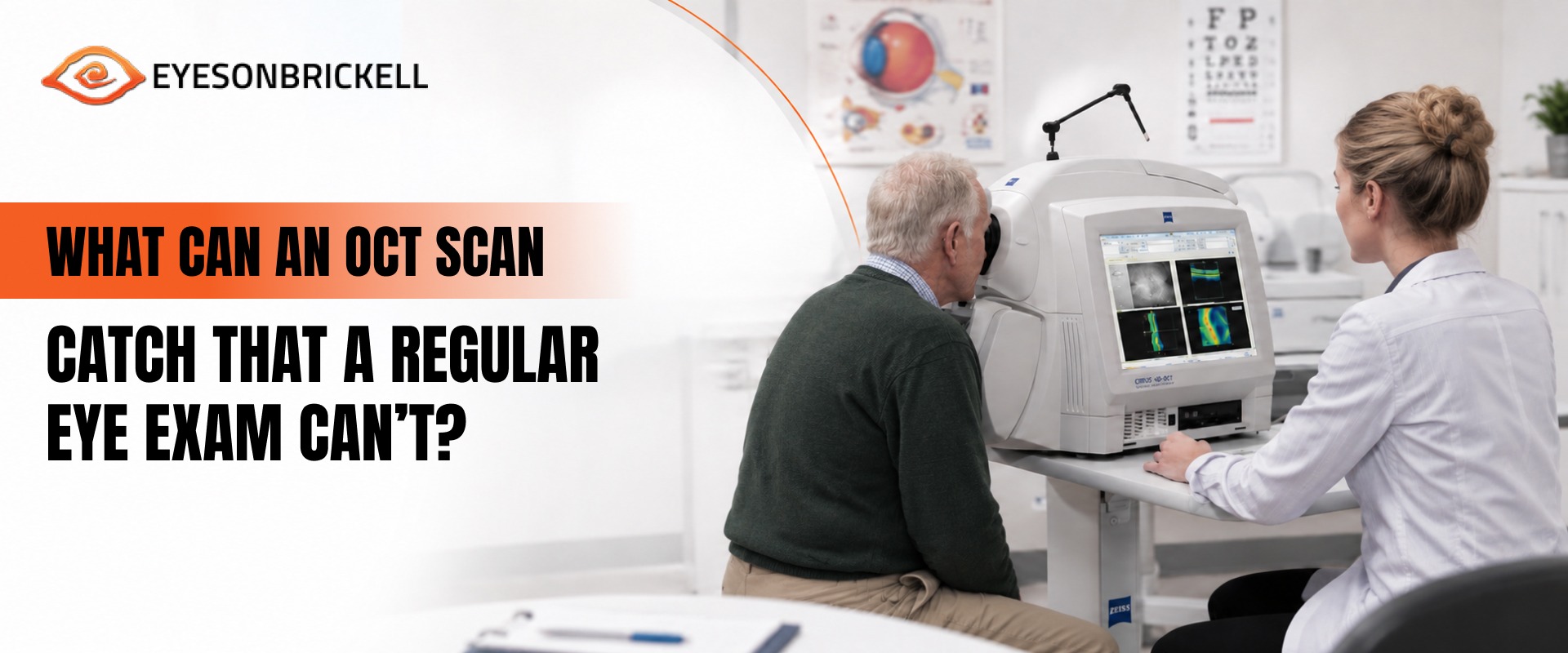
An OCT eye test is generally quick and non-invasive. You sit in front of the OCT device with your head positioned against a support while the machine scans your eye without touching it. The scan itself can take only a few minutes.
Depending on the examination, your pupils may or may not need to be dilated.
The scan produces detailed images that your eye care professional can review alongside your other examination findings.
Looking for OCT Testing in Miami?
If you are searching for OCT testing in Miami or an OCT eye test in Miami, choosing a practice that can combine advanced imaging with a comprehensive eye evaluation is important.
Eyes on Brickell in Miami offers OCT testing as part of its advanced diagnostic services, along with comprehensive eye exams, retinal exams, glaucoma exams and other specialized eye care services.
Located in Brickell at 2885 SW 3rd Ave, Suite 100, Eyes On Brickell serves patients looking for comprehensive and advanced eye care in the Miami area.
The Bottom Line
A regular eye exam tells your doctor important information about your vision and overall eye health. An OCT eye test can take that evaluation further by providing detailed images of the retina, macula and optic nerve.
That extra information can be valuable for detecting, diagnosing or monitoring changes associated with conditions such as glaucoma, macular degeneration and diabetic eye disease.
So, if you have been searching for an oct eye test near me, don’t simply look for the closest testing center. Look for an eye care practice where OCT imaging can be interpreted as part of a complete evaluation of your eye health.
Eyes On Brickell provides OCT testing in Miami along with comprehensive eye care to help you understand what’s happening beneath the surface of your vision.
Visit at 2885 SW 3rd Ave, Suite 100, Miami, FL 33129 today and book your appointment.