Dry Eye Treatment in Brickell: A Complete Guide to Lasting Relief
If your eyes feel gritty by lunchtime, burn after a few hours at your laptop, or water uncontrollably on the walk to the office, you’re not imagining it, and you’re not alone.
Dry eye is one of the most common reasons Brickell residents book an eye exam, and Miami’s climate, screen-heavy work culture, and high rate of contact lens wear make it more common here than in most cities.
The good news: dry eye treatment in Brickell has come a long way from “just use more drops.”
At Eyes on Brickell, Dr. Antoine Copty and his team diagnose the specific cause of your dry eye and build a treatment plan around it, whether that means prescription drops, in-office gland therapy, or advanced IPL treatment.
This guide walks you through everything: what dry eye actually is, why it’s so common in Brickell, how it’s diagnosed, and every treatment option available to you, from the simplest to the most advanced.
What Is Dry Eye Syndrome?
Dry eye syndrome (also called dry eye disease or ocular surface disease) happens when your eyes can’t maintain a healthy layer of tears on their surface, either because you’re not producing enough tears, or because the tears you do produce evaporate too quickly or aren’t the right quality to keep your eyes comfortable and protected.
Your tear film isn’t just water. It’s a three-layer structure of oil, water, and mucus that has to work together to keep your eyes lubricated, clear, and protected from irritants.
When any one of those layers breaks down, most often the oil layer, the whole system becomes unstable, and dryness, irritation, and even blurry vision follow.
Dry eye is a chronic condition for most people, which means it typically isn’t something you cure once and never think about again. It’s something you manage effectively with the right plan for dry eye treatment in Brickell, and for the vast majority of patients, that management makes a real, lasting difference in daily comfort.
Common Symptoms of Dry Eye
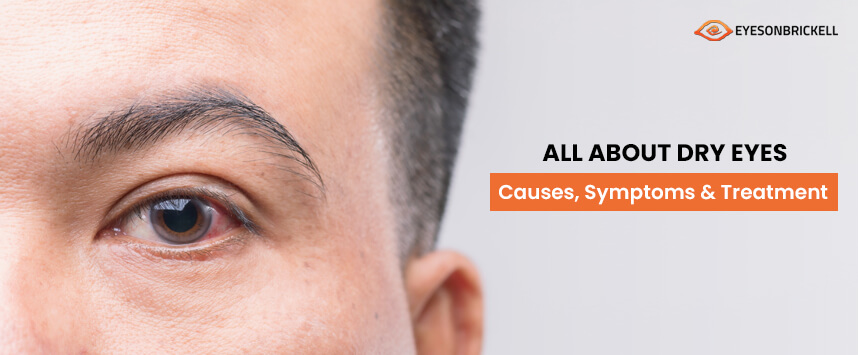
Dry eye symptoms can show up differently from person to person, but the most common signs patients describe at our Brickell office include:
- A gritty, sandy, or “something in my eye” sensation.
- Burning or stinging, especially by mid-afternoon.
- Redness that comes and goes.
- Excessive watering (yes, watery eyes are often a symptom of dryness, as your eyes overcompensate).
- Blurry vision that improves with blinking.
- Light sensitivity.
- Discomfort or difficulty wearing contact lenses.
- Eye fatigue during screen work or reading.
- Stringy mucus in or around the eyes.
If several of these sound familiar and they’ve been going on for weeks rather than days, it’s worth having your eyes properly evaluated rather than continuing to cycle through different over-the-counter drops.
Causes of Dry Eye
Dry eye disease usually comes down to one of two mechanisms, and often both together:
- Not enough tear production (aqueous-deficient dry eye), related to aging, certain medications, autoimmune conditions like Sjögren’s syndrome, or hormonal changes.
- Poor-quality tears that evaporate too fast (evaporative dry eye), most often caused by meibomian gland dysfunction (MGD), where the oil-producing glands along your eyelids become blocked or underperform, so the tear film’s protective oil layer breaks down.
Common contributing factors include:
- Prolonged screen time (we blink roughly half as often when staring at a screen).
- Contact lens wear.
- Indoor air conditioning and low humidity.
- Certain medications (antihistamines, antidepressants, blood pressure medications, birth control).
- Hormonal changes, particularly in women after menopause.
- Autoimmune and inflammatory conditions.
- Previous LASIK or other eye surgery.
- Blepharitis and eyelid inflammation.
- Aging, tear production naturally declines over time.
Why Dry Eye Is So Common in Brickell & Miami
Brickell’s lifestyle is, unfortunately, a near-perfect storm for dry eye disease. A few local realities make it especially common here:
- Aggressive year-round air conditioning. Miami’s heat means AC runs constantly in homes, offices, and high-rises, and cold, dry recirculated air is one of the most reliable ways to dry out your tear film.
- A screen-heavy, high-hours work culture. Brickell’s concentration of finance, law, and corporate offices means long hours in front of monitors, which reduces blink rate and accelerates tear evaporation.
- High contact lens usage. Between the professional dress-code culture and active lifestyle, contact lens wear is common in Brickell, and lenses are a well-known contributor to dryness.
- Humidity swings between indoors and outdoors. Moving repeatedly between humid outdoor air and cold, dry indoor air stresses the tear film more than a stable climate would.
- Wind and sun exposure. Waterfront living and outdoor activity (running the Baywalk, boating, biking) increase evaporative tear loss.
If you’ve noticed your eyes feel worse at your desk than on weekends, this local combination of AC, screens, and lens wear is very likely part of the reason.
Who Is at Risk for Dry Eye?
You may be at higher risk for dry eye disease if you:
- Are over 50 (tear production declines with age).
- Are a woman, particularly post-menopause.
- Wear contact lenses regularly.
- Spend more than 6 hours a day on screens.
- Have had LASIK or other refractive eye surgery.
- Have an autoimmune condition such as Sjögren’s syndrome, lupus, or rheumatoid arthritis.
- Take antihistamines, antidepressants, or certain blood pressure medications.
- Live or work in air-conditioned environments most of the day.
- Have a history of eyelid inflammation (blepharitis) or rosacea.
Types of Dry Eye
Understanding which type you have is the difference between drops that work and drops that don’t:
| Type | What’s happening | Typical cause |
|---|---|---|
| Evaporative dry eye | Tears evaporate too quickly due to an unstable oil layer | Meibomian gland dysfunction (most common type) |
| Aqueous-deficient dry eye | Not enough tear volume is produced | Aging, autoimmune disease, certain medications |
| Mixed dry eye | A combination of both mechanisms | Common in long-standing, untreated cases |
Most chronic dry eye patients we see in Brickell have an evaporative component driven by meibomian gland dysfunction, which is exactly why gland-focused treatments like IPL and gland expression have become such an important part of modern dry eye treatment in Brickell.
How Dry Eye Is Diagnosed
A proper dry eye evaluation goes well beyond “do your eyes feel dry?” At Eyes on Brickell, a trusted dry eye treatment center in Miami, a comprehensive dry eye evaluation typically includes:
- A detailed symptom and medical history review, including medications, screen habits, and contact lens use.
- Tear film assessment to measure tear quantity and how quickly your tear film breaks down.
- Meibomian gland evaluation, often using specialized imaging to see whether the oil-producing glands are blocked, atrophied, or functioning normally.
- Ocular surface examination to check for inflammation, staining patterns, and eyelid margin health.
- Discussion of your specific triggers, work environment, lens wear, prior surgeries, so your treatment plan matches your actual cause, not just your symptoms.
This is the step most over-the-counter approaches skip entirely, and it’s why patients who’ve “tried everything” from the drugstore often finally get relief once the underlying cause is identified.
Dry Eye Treatment Options in Brickell
Dry eye treatment in Brickell is built around your specific diagnosis, but the toolkit generally includes:
- Artificial tears and lubricating drops — the first line of defense for mild cases, though not all drops are created equal; preservative-free formulas are generally gentler for frequent use.
- Prescription anti-inflammatory drops (such as cyclosporine-based medications), for patients whose dry eye has an inflammatory component that artificial tears alone can’t address.
- Punctal plugs — tiny, virtually unnoticeable devices inserted into the tear ducts to slow tear drainage and keep your natural tears on the eye’s surface longer.
- Meibomian gland expression — an in-office procedure where your eyelid glands are gently cleared to restore healthy oil flow into the tear film.
- Eyelid hygiene treatments — including medical-grade lid-cleansing regimens to control the bacteria, debris, and biofilm that contribute to gland blockage and blepharitis.
- Omega-3 supplementation — often recommended alongside other treatments to support tear film oil quality.
- Environmental and lens adjustments — including switching to dry-eye-friendly contact lens materials or wear schedules.
Advanced Treatment Options: IPL & Gland Therapy
For patients with chronic or moderate-to-severe dry eye, especially cases driven by meibomian gland dysfunction, Eyes on Brickell offers Intense Pulsed Light (IPL) therapy, one of the most effective advanced dry eye treatments in Brickell available for evaporative dry eye.
IPL uses controlled pulses of light applied around the eyelids to:
- Reduce the chronic inflammation that keeps meibomian glands blocked.
- Help unblock and reopen the glands themselves.
- Improve the flow of natural oils into your tear film.
- Stabilize tear film quality over a series of sessions.
Most patients complete a series of 3–4 short sessions, spaced a few weeks apart, with minimal downtime, many return to normal activities the same day.
IPL doesn’t just mask symptoms the way drops can; it targets the underlying gland dysfunction that’s often the real reason chronic dry eye doesn’t respond to drops alone.
IPL is FDA-cleared for dry eye management and is typically recommended for patients who’ve tried artificial tears without lasting relief, or who have visible signs of meibomian gland dysfunction on evaluation.
Lifestyle & Home Care Tips
Alongside professional dry eye treatment in Miami, these habits can meaningfully reduce symptoms between visits:
- Follow the 20-20-20 rule: every 20 minutes, look at something 20 feet away for 20 seconds to reset your blink rate.
- Use a humidifier at your desk or bedroom to counter AC-driven dryness.
- Apply a warm compress to your eyelids for a few minutes daily to help keep oil glands flowing.
- Stay hydrated and consider omega-3-rich foods (or a supplement, if recommended by your doctor).
- Take contact lens breaks — even a few lens-free hours a day can help.
- Wear wraparound sunglasses outdoors to reduce wind and evaporative tear loss.
- Avoid pointing car or home AC vents directly at your face.
These steps help, but they’re not a substitute for treating the underlying cause, especially if you already have gland dysfunction or chronic inflammation.
When to See an Eye Doctor for Dry Eye
Book an evaluation if you experience:
- Dryness, burning, or grittiness lasting more than a few weeks.
- Symptoms that interfere with work, screen time, or contact lens wear.
- Redness that keeps returning.
- Blurry or fluctuating vision.
- No lasting improvement from over-the-counter drops.
- Eye pain, discharge, or sudden vision changes (seek care promptly).
The earlier meibomian gland dysfunction is caught, the more treatable it is, untreated gland blockage can become permanent gland loss over time.
Why Choose Eyes on Brickell for Dry Eye Treatment
Eyes on Brickell is a Brickell-based eye care practice led by Dr. Antoine Copty, an internationally trained Optometric Physician with more than two decades of experience. Patients choose us for dry eye care because we:
- Diagnose the specific cause of your dry eye rather than guessing.
- Offer the full treatment spectrum in one location, from drops to punctal plugs to advanced IPL therapy.
- Use dedicated diagnostic technology to evaluate your tear film and meibomian glands.
- Provide bilingual, personalized care in the heart of Brickell.
- Offer flexible scheduling, including same-day and evening appointments, with free parking.
You can find us at 2885 SW 3rd Ave, Suite 100, Miami, FL 33129, a short walk from most of Brickell’s residential towers and office buildings.
Frequently Asked Questions
1. What is the best dry eye treatment in Brickell?
The best treatment depends on your specific cause. Mild cases often respond to preservative-free artificial tears, while chronic or gland-related dry eye typically responds best to a combination of prescription drops, meibomian gland therapy, and, for moderate-to-severe cases, IPL treatment.
2. How much does dry eye treatment cost in Miami?
The costs for dry eye treatment in Miami vary depending on the treatments involved, a diagnostic exam, prescription drops, and any in-office procedures like IPL are priced differently. Many services are covered in part by vision or medical insurance. Contact our office for a personalized cost estimate after your evaluation.
3. Is dry eye treatment covered by insurance?
Diagnostic exams and some prescription treatments are often covered by medical or vision insurance, though coverage for advanced procedures like IPL varies by plan. Our team can help verify your specific benefits.
4. How long does it take to see results from dry eye treatment?
Artificial tears provide immediate, temporary relief. Prescription drops typically take 4–8 weeks to show full effect. IPL treatment often produces noticeable improvement within a few sessions, with most patients completing a series of 3–4 treatments over several weeks.
5. Can dry eye be cured, or only managed?
For most patients, dry eye is a chronic condition that’s managed rather than permanently cured, but with the right treatment plan, most people achieve long-term comfort and significantly reduced symptoms.
6. Is IPL treatment for dry eye painful?
Dry eye is painful as most patients describe IPL as a mild warming or slight snapping sensation, not painful. Sessions are quick, generally well tolerated, and require no real downtime.
7. Why does Miami’s climate make dry eye worse?
Constant air conditioning, humidity swings between indoor and outdoor environments, and sun/wind exposure from outdoor living all increase tear evaporation, which is why dry eye is especially common among Miami and Brickell residents.
8. Can contact lens wearers get dry eye treatment?
Yes. In fact, contact lens wearers are a high-risk group for dry eye. Treatment can include lens material changes, wear-schedule adjustments, and standard dry eye therapies alongside your contact lens care.
Conclusion
Dry eye is common, especially if you live or work in Brickell, but “common” doesn’t mean you have to live with it. Whether your symptoms are occasional and mild or chronic and disruptive, an accurate diagnosis is the fastest path to real relief, and effective treatment options exist at every level, from simple drops to advanced IPL therapy.
Ready to stop guessing and start treating the actual cause of your dry eyes?
Schedule a comprehensive dry eye evaluation with Dr. Antoine Copty and the team at Eyes on Brickell today, and take the first step toward lasting comfort.
Book Your Dry Eye Evaluation in Brickell at 2885 SW 3rd Ave, Suite 100, Miami, FL 33129