Most Parents Think Myopia Is Just About Updating Glasses Every Year – But It’s Not
When a child starts struggling to see the board at school, many parents assume the solution is simple: schedule an eye exam, get a stronger pair of glasses, and move on.
But what if your child needs a stronger prescription again the following year?
And then again the year after that?
This pattern can be more than a routine need for updated eyewear. It may be a sign that your child’s myopia (nearsightedness) is progressing.
Myopia is becoming increasingly common worldwide. A recent National Academies report notes that, if current trends continue, approximately 5 billion people could be nearsighted by 2050.
That is why modern eye care is increasingly looking beyond simply correcting blurry vision and toward myopia control, strategies designed to help slow myopia progression.
A Stronger Prescription Corrects Vision-But Does It Control Myopia?
This is one of the most important distinctions parents should understand.
Traditional single-vision glasses can correct the blurry distance vision caused by myopia. Your child may see the classroom board clearly again, read signs more easily, and perform everyday activities comfortably.
However, correcting the blur does not necessarily mean the underlying myopia has stopped progressing.
Myopia is associated with changes in the eye, including excessive elongation of the eyeball. Greater levels of myopia are associated with an increased lifetime risk of eye conditions such as retinal detachment, glaucoma, and myopic macular degeneration.
That is why the conversation shouldn’t stop at, “What prescription does my child need?”
A more useful question may be:
“Is my child’s myopia changing, and should we consider a myopia management approach?”
Why Are More Children Developing Myopia?
There isn’t one single cause of childhood myopia.
Genetics can play a role, but environmental and lifestyle factors are also important. Research has linked myopia with factors such as increased near-work demands and reduced time outdoors.
The increase has been particularly noticeable in parts of Asia. The World Health Organization reports that myopia prevalence has risen dramatically in the Western Pacific region, from around 20% in the mid-20th century to nearly 50% among adolescents in countries such as Singapore and China, with some areas reporting rates around 80% among young adults.
For parents, the takeaway isn’t that every child who spends time reading or using a screen will develop myopia.
It’s that myopia is a complex condition, and simply replacing glasses every year may not address the bigger picture.
The “New Glasses Every Year” Pattern Parents Shouldn’t Ignore
Imagine this:
Your child receives a prescription for -1.00 D.
A year later, it becomes -1.50 D.
Another year passes, and now it’s -2.00 D.
The numbers may look like nothing more than changes in a prescription. But repeated increases can indicate that myopia is progressing.
This is why regular comprehensive eye examinations are important for children, particularly when their prescription appears to be changing quickly.
An eye care professional can monitor changes in vision and, when appropriate, discuss whether myopia control should be considered.
What Is Myopia Control?
Myopia control is also called myopia management – an approach of using evidence-based strategies to help slow the progression of myopia rather than simply correcting the vision it causes.
Depending on the child’s age, prescription, eye health, lifestyle, and other factors, an eye care professional may discuss different approaches.
These can include:
- Specialized myopia control glasses
- Specialized myopia control contact lenses
- Certain multifocal or specially designed contact lenses
- Orthokeratology in appropriate cases
- Pharmacological approaches such as low-dose atropine
- Lifestyle strategies, including encouraging appropriate outdoor time
The right option isn’t identical for every child. Myopia management should be individualized and monitored by an eye care professional.
Myopia Control Glasses vs. Regular Glasses
Parents may wonder: “If my child already wears glasses, what’s different about myopia control glasses?”
Regular single-vision glasses primarily provide clear vision by correcting the refractive error.
Specialized myopia-control spectacle lenses are designed with optical features intended to influence peripheral retinal image focus and help slow myopia progression.
Research on newer spectacle lens designs has shown promising results. For example, EyeWiki from the American Academy of Ophthalmology reports that a clinical study of highly aspheric lenslets found a 71% reduction in myopia progression at 24 months compared with single-vision lenses, along with a 53% reduction in axial eye elongation.
That doesn’t mean every child will experience the same result. Treatment effectiveness can vary, which is why professional assessment and follow-up matter.
What About Myopia Control Contact Lenses?
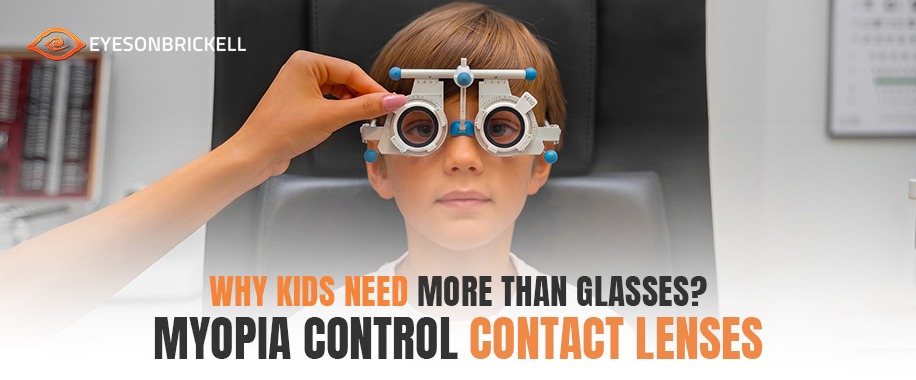
For children who are suitable candidates for contact lens wear, myopia control contact lenses are another option parents may discuss with an eye care professional.
Unlike conventional contact lenses that primarily correct refractive error, certain specialized lenses are designed to provide optical signals that may help slow the progression of myopia.
One of the best-known examples is MiSight 1 day. In a randomized, double-masked clinical trial, children who wore the lenses experienced a 59% slower rate of myopia progression and a 52% slower rate of axial elongation over three years compared with the control group wearing single-vision contact lenses.
These results are significant because they highlight the difference between simply helping a child see clearly and actively addressing myopia progression.
Contact lenses aren’t appropriate for every child, however. An eye care professional should determine whether a child is ready for contact lenses and whether a particular lens is appropriate.
Does Spending More Time Outdoors Help?
Lifestyle habits can also be part of a broader approach to myopia management.
Research has found an association between increased outdoor exposure and a lower risk of developing myopia in children. A systematic review also notes that reduced outdoor time and increased near-work activities may contribute to the changing prevalence of myopia.
This doesn’t mean outdoor time replaces professional myopia management.
Instead, parents can think of it as one potentially helpful part of a child’s overall eye-health routine.
Encouraging children to spend regular time outdoors, take appropriate breaks during prolonged near work, and maintain regular eye examinations can support healthier visual habits.
5 Signs Parents Should Pay Attention To
1. Your Child Needs Stronger Glasses Frequently
If the prescription keeps increasing during childhood, ask the eye care professional whether the myopia is progressing.
2. Your Child Sits Very Close to the TV or Screen
Consistently moving closer to see clearly can be a sign that distance vision needs to be checked.
3. Your Child Struggles to See the Classroom Board
Squinting, moving closer, or frequently asking what is written on the board can indicate distance-vision difficulties.
4. Your Child Complains About Blurry Distance Vision
If distant objects become increasingly difficult to see, don’t simply wait until the next routine glasses replacement.
5. There Is a Family History of Myopia
Children with myopic parents may have a higher risk of developing myopia, making regular monitoring particularly important.
The Goal Isn’t Just “Better Glasses”
Glasses remain an important part of helping children see clearly. The point isn’t that parents should stop updating prescriptions.
The bigger idea is that clear vision and myopia management are not necessarily the same thing.
If a child’s prescription is changing repeatedly, parents may benefit from asking questions beyond:
“What strength of glasses does my child need?”
Consider asking:
- Is my child’s myopia progressing?
- Should we monitor axial length?
- Is my child a candidate for myopia control lenses?
- Would myopia control contact lenses be appropriate?
- Would myopia control glasses be a better option?
- How often should my child’s eyes be monitored?
These questions can help parents have a more informed conversation about their child’s long-term eye health.
Don’t Wait for the Next Stronger Prescription
If your child needs stronger glasses every year, don’t automatically assume it’s just part of growing up. A changing prescription can be an important reason to discuss myopia control with an eye care professional.
At Eyes On Brickell, a comprehensive eye examination can help assess your child’s vision and provide guidance based on their individual needs.
Clear vision matters today. Protecting your child’s eye health for the future matters too.
Visit us at: 2885 SW 3rd Ave Suite 100, Miami, FL 33129 Today!