Could Contact Lenses Slow Your Child’s Nearsightedness? A Miami Parent’s Guide
Medically reviewed by Dr. Antoine Copty, OD — Eyes On Brickell, Brickell, Miami, FL. Last updated: July 2026.
If your child’s glasses prescription keeps getting stronger every year, you’re not imagining it, and you’re not alone. Childhood myopia (nearsightedness) is rising fast, and once it starts, it usually keeps progressing through the school years. The encouraging news for parents in Brickell and across Miami is that we can now do far more than simply hand out a stronger pair of glasses each visit. Myopia control contact lenses and related treatments are clinically proven to slow how quickly a child’s nearsightedness worsens, protecting their vision for life, not just for this school year.
This guide walks you through every myopia control option, how each one works, how well it works, who it’s right for, what it costs, and how to decide, so you can walk into your child’s next eye exam knowing exactly what to ask.
What Is Myopia (Nearsightedness)?
Myopia is a common vision condition where distant objects look blurry while close-up objects stay clear. It happens when the eyeball grows slightly too long, so light focuses just in front of the retina instead of directly on it. Myopia usually begins in childhood, between ages 6 and 14, and tends to worsen as a child grows.
Because the eye keeps physically lengthening, myopia is progressive, which is exactly why early management matters so much.
Why Myopia Gets Worse, and Why Slowing It Matters
Every time your child’s eye lengthens, their prescription climbs. Left unmanaged, mild childhood myopia can progress into high myopia by the teenage or young-adult years. This isn’t only about thicker lenses, higher myopia is linked to a meaningfully greater lifetime risk of serious eye conditions, including retinal detachment, myopic maculopathy, early cataracts, and glaucoma. Research suggests that slowing progression by even one diopter can significantly lower the lifetime risk of myopia-related retinal damage.
That’s the whole goal of myopia control: not to reverse nearsightedness, but to slow the eye’s elongation during the years it grows fastest, so your child ends up with a lower final prescription and a healthier eye for decades to come.
What Are Myopia Control Contact Lenses?
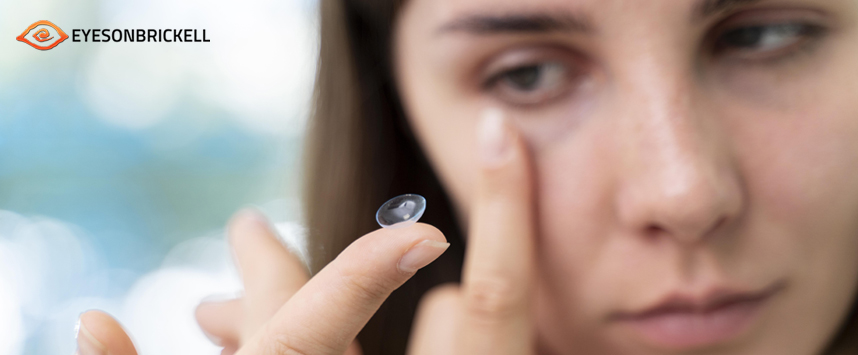
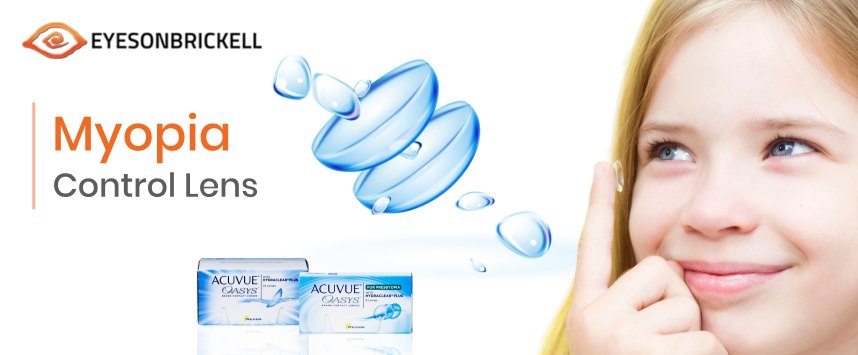
Myopia control contact lenses are specially designed lenses that correct your child’s blurry distance vision and slow the progression of their nearsightedness at the same time. Unlike standard contacts or glasses, which simply sharpen vision, these lenses use a special optical design that changes how light focuses on the peripheral retina, sending the eye a “stop growing so fast” signal. The result is slower axial elongation and a lower final prescription.
There are several proven approaches to myopia control. The best choice depends on your child’s age, prescription, lifestyle, and maturity, which is why a proper myopia consultation matters more than any single “best” product.
The Main Myopia Control Options Compared
| Treatment | How it works | Typical candidate | Proven slowing* | Worn | Approx. cost/yr |
|---|---|---|---|---|---|
| MiSight 1 day (soft contact) | Dual-focus daily-disposable lens | Ages 8–12 at start, −0.75 to −4.00 D | Up to ~59% | Daytime, thrown away nightly | ~$1,400–1,600 |
| Orthokeratology (Ortho-K) | Rigid lens reshapes the cornea overnight | Kids/teens wanting lens-free days | ~40–70% | Overnight only | ~$1,000–4,000 (Year 1) |
| Soft multifocal (e.g., Abiliti, NaturalVue) | Peripheral-defocus soft lens | Broader age/prescription range | ~25–70% | Daytime | ~$500–1,200 |
| Myopia control glasses (DIMS/HAL) | Lenslet defocus spectacle lenses | Kids not ready for contacts | ~50–67% | Daytime glasses | Varies by lens |
| Low-dose atropine (0.01–0.05%) | Nightly eye drop | Younger kids, or as add-on therapy | ~27–67% | 1 drop nightly | Lower; often combined |
*Reduction in myopia progression vs. standard single-vision correction, from published clinical trials. Individual results vary; effectiveness ranges reflect different studies, designs, and patient ages.
MiSight 1 day Contact Lenses
MiSight (by CooperVision) is the first and only soft contact lens FDA-approved specifically to slow the progression of myopia in children. It’s a daily disposable, a fresh, clean lens each morning, tossed each night which makes it one of the healthiest and lowest-maintenance options for kids. The FDA indication is for children who are 8–12 years old at the start of treatment with a prescription of −0.75 to −4.00 diopters and healthy eyes.
In CooperVision’s landmark 3-year clinical trial, MiSight slowed myopia progression by about 59% on average, and roughly 41% of treated eyes showed no progression at all. Follow-up data out to 6 years found the benefit was retained with no rebound after treatment ended. For many Miami families, the daily-disposable convenience and strong evidence base make MiSight a first-line choice.
Orthokeratology (Ortho-K)
Ortho-K uses custom rigid lenses worn only overnight to gently reshape the cornea while your child sleeps so they wake up seeing clearly all day with no glasses or daytime contacts. The reshaping is temporary and fully reversible; stop wearing the lenses and the cornea returns to its original shape. Studies show Ortho-K can meaningfully slow myopia progression while giving kids lens-free days for sports and swimming.
Ortho-K has an excellent safety record when properly fitted and monitored, but because the lenses are worn overnight, careful hygiene and regular follow-ups are essential to minimize infection risk. We cover the practical realities in our guide to what to know about Ortho-K and compare it head-to-head with soft options in Ortho-K vs traditional contact lenses.
Soft Multifocal Lenses (Including Acuvue Abiliti)
Soft multifocal and dual-focus lenses, including Johnson & Johnson’s Acuvue Abiliti family and other peripheral-defocus designs, offer daytime wear with a broader fitting range than MiSight’s FDA age window. Some are used off-label for myopia control and can be a great fit for children slightly outside the MiSight parameters. Effectiveness varies by design, but multifocal soft lenses have slowed progression by roughly 25–72% across clinical studies. Learn more about the Acuvue Abiliti myopia control lenses.
Myopia Control Glasses
For children who aren’t ready for contact lenses, myopia control glasses (using DIMS or highly aspherical lenslet technology, such as MiYOSMART or Stellest lenses) offer a non-contact way to slow progression, with some studies showing reductions of 50–67%. They look and function like normal glasses, which makes compliance easy for younger kids. If glasses are the right starting point, our guide to choosing glasses for myopia walks through the details.
Low-Dose Atropine Eye Drops
A single nightly drop of low-dose atropine (typically 0.01% to 0.05%) has been shown to slow myopia progression, with higher concentrations generally more effective but slightly more likely to cause light sensitivity or near-vision blur. Atropine is often used in younger children or combined with a myopia control lens for an additive effect. Because progression can rebound if atropine is stopped abruptly, treatment is tapered under an eye doctor’s guidance.
MiSight vs Ortho-K: Which Is Right for My Child?
MiSight is usually best for families who want a simple, low-maintenance daily lens with the strongest FDA-backed evidence, while Ortho-K suits active kids who want completely lens-free days for sports and swimming. MiSight is worn during the day and discarded nightly; Ortho-K is worn only overnight and reshapes the cornea while sleeping. Both slow progression effectively, the right pick comes down to your child’s age, prescription, lifestyle, and comfort with each routine.
Is My Child a Candidate? Age, Prescription & Safety
Most children who are motivated and reasonably responsible can succeed with myopia control, kids as young as 8 routinely handle daily contacts safely with a little parental help. During a myopia consultation, we consider your child’s age, current prescription and how fast it’s changing, eye health, hygiene habits, and daily activities to recommend the safest, most effective option. Daily-disposable lenses like MiSight are considered the healthiest soft-lens option for children because there’s no cleaning or storage and a fresh lens every day lowers infection risk.
How Much Do Myopia Control Lenses Cost?
Myopia management is an investment in protecting your child’s vision for life, and pricing reflects the specialty fitting, custom lenses, and frequent follow-ups involved. As a general guide: soft options like MiSight often run around $1,000–1,600 per year including lenses and visits, while Orthokeratology commonly ranges from $1,000–4,000 in the first year (with lower costs in following years). Atropine-based plans tend to cost less and are sometimes combined with lenses. Vision insurance coverage for myopia control varies widely, many plans offer limited reimbursement, so we’ll always review your specific benefits and costs before you commit.
Signs Your Child May Have Myopia
Children rarely say “I can’t see the board.” Instead, watch for squinting, sitting very close to the TV or holding devices close, frequent eye rubbing, headaches, sitting at the front of the classroom to see, or a drop in schoolwork or interest in distance activities. Because kids adapt to blur without complaining, a yearly comprehensive eye exam is the most reliable way to catch, and start managing, myopia early.
Myopia Control in Brickell & Miami – Eyes On Brickell
At Eyes On Brickell, Dr. Antoine Copty and our team provide dedicated myopia management for children and teens right here in Brickell, serving families across Miami, Hialeah, Weston, and greater South Florida. We fit MiSight, Ortho-K, soft multifocal lenses, and myopia control glasses, and we build a personalized plan around your child, then monitor progression closely with each visit so we can adjust as they grow. Our pediatric eye care services are designed to make the whole process comfortable for kids and reassuring for parents. If you’re wondering why specialty pediatric care matters, here’s why choosing a pediatric eye specialist is different.
Visit us at: 2885 SW 3rd Ave Suite 100, Miami FL 33129 Today!
Frequently Asked Questions
How do myopia control contact lenses work?
Myopia control contact lenses correct distance vision while using a special optical design that alters how light focuses on the peripheral retina. This signals the eye to slow its elongation, which reduces how quickly a child’s nearsightedness progresses compared with standard lenses or glasses.
Is Ortho-K worth it?
For many families, yes. Ortho-K reshapes the cornea overnight so kids enjoy clear, lens-free vision all day, ideal for sports and swimming, while also slowing myopia progression. It requires good hygiene and regular follow-ups, and the effect is fully reversible if you stop.
At what age can my child start myopia control?
Myopia control can begin as soon as progression is detected, often around ages 6–8. MiSight is FDA-approved for children starting at 8–12 years old, while other lenses, glasses, and atropine can be used across a wider age range under an eye doctor’s guidance.
How effective is myopia control?
Very effective for slowing progression. Depending on the method, published trials report reductions of roughly 25% to 70% versus standard correction, for example, MiSight slowed progression by about 59% over three years. Results vary by child, treatment, and how early it’s started.
Does insurance cover myopia control contact lenses?
Coverage varies widely. Many vision plans provide only limited reimbursement for myopia management because it’s considered a specialty service. At Eyes On Brickell, we review your specific benefits and give you clear pricing before starting treatment.
Can myopia be cured?
Myopia can’t currently be cured or reversed, because it’s caused by the physical length of the eye. However, myopia control treatments can significantly slow its progression, resulting in a lower final prescription and reduced lifetime risk of serious eye problems.
Eyes On Brickell — Family Eye Care in Brickell, Miami, FL. This article is for educational purposes and isn’t a substitute for a personalized exam. Book a consultation to discuss the best myopia control plan for your child.