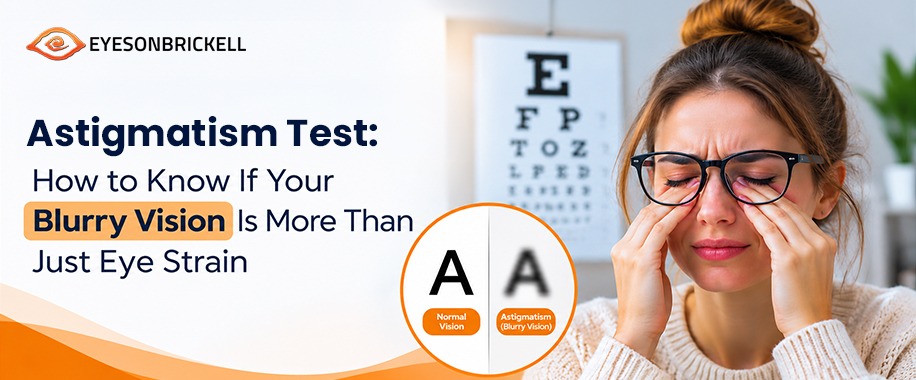
Astigmatism Test: How to Know If Your Blurry Vision Is More Than Just Eye Strain
Have you ever noticed that road signs look slightly blurry, words appear distorted while reading, or lights seem stretched, especially at night? You might assume these problems are caused by spending too much time looking at screens or simply feeling tired. However, persistent blurry vision can sometimes indicate an underlying vision problem called astigmatism.
Astigmatism is a common refractive error that occurs when the cornea or lens has an irregular shape, preventing light from focusing properly on the retina. The result can be blurred or distorted vision at different distances.
The good news is that an astigmatism test can help identify this condition and determine the right vision correction. But how do you know when blurry vision is just eye strain and when it is time to schedule an eye examination? Let’s explore.
Is It Eye Strain or Could It Be Astigmatism?
Both eye strain and astigmatism can cause blurry vision, headaches, and difficulty focusing. However, there are some differences worth understanding.
Eye strain often develops after prolonged activities such as reading, working on a computer, or using a smartphone. Symptoms may improve after resting your eyes, taking breaks, or reducing screen time.
Astigmatism, on the other hand, is related to the shape of the cornea or lens. Its symptoms may persist even after resting because the eye’s focusing problem remains.
Here are some common signs that may indicate astigmatism:
- Blurred vision: Objects may appear unclear or slightly distorted at both near and far distances.
- Frequent headaches: Your eyes may work harder to focus, potentially leading to headaches.
- Night vision difficulties: Lights from vehicles, streetlights, and other sources may appear streaky, stretched, or surrounded by halos.
- Squinting frequently: You may find yourself squinting to make objects appear sharper.
- Eye fatigue: Reading, driving, or working on digital screens may become uncomfortable.
- Difficulty seeing fine details: Letters, numbers, and small objects may appear less defined.
If you regularly experience these symptoms, scheduling an eye exam for astigmatism can help determine whether a refractive error is affecting your vision.
What Is an Astigmatism Test?
An astigmatism test is part of a comprehensive eye examination that helps an eye care professional determine whether your cornea or lens has an irregular curvature.
Unlike conditions that primarily affect near or distance vision, astigmatism can cause blurred or distorted vision at multiple distances.
During the examination, your eye doctor evaluates how light enters and focuses inside your eyes. Different diagnostic techniques may be used to measure the shape and focusing power of your eyes.
An eye test for astigmatism is generally straightforward, non-invasive, and does not require any special preparation.
What Tests Are Used to Detect Astigmatism?
Your eye doctor may use several testing methods to identify and measure astigmatism. Each test provides different information about your vision and eye structure.
1. Visual Acuity Test
A visual acuity test is one of the most familiar parts of an eye examination. You will be asked to read letters or symbols from an eye chart positioned at a specific distance.
The test helps measure how clearly you can see and whether your vision is affected by refractive errors such as astigmatism, nearsightedness, or farsightedness.
2. Refraction Test
A refraction test helps determine the exact prescription needed to correct your vision.
Your eye doctor may ask you to look through a device called a phoropter while switching between different lenses. You will be asked which option makes the letters or images appear clearer.
This process helps identify the amount of astigmatism correction required in your eyeglass or contact lens prescription.
3. Keratometry Test
A keratometry test measures the curvature of your cornea, which is the clear front surface of your eye.
Since astigmatism frequently occurs because of an irregularly shaped cornea, measuring its curvature helps your eye doctor understand how it affects your vision.
This test is particularly useful when evaluating patients who may benefit from specialized contact lenses.
4. Corneal Topography
Corneal topography creates a detailed map of your cornea’s surface. It helps identify irregularities in its shape and curvature that may contribute to distorted vision.
Unlike basic curvature measurements, corneal topography provides a more comprehensive picture of the cornea.
It can be especially helpful when evaluating more complex cases of astigmatism or determining whether additional corneal conditions need attention.
How Do You Read an Astigmatism Prescription?
After completing an astigmatism eye test, your eye doctor may provide a prescription containing specific numbers that describe your refractive error.
Understanding these values can help you make sense of your vision correction needs.
Here are three important terms you may find on your prescription:
- Sphere (SPH): Indicates the degree of nearsightedness or farsightedness.
- Cylinder (CYL): Measures the amount of astigmatism correction required.
- Axis: Specifies the orientation of astigmatism correction, measured in degrees from 1 to 180.
For example, a prescription with a cylinder value of -1.25 indicates that you need 1.25 diopters of astigmatism correction. The axis tells your eye care professional the direction in which that correction should be positioned.
Your prescription may look complicated at first, but your optometrist can explain what each measurement means for your individual vision needs.
Can Astigmatism Be Corrected?
Yes! Astigmatism can generally be corrected with the right vision correction based on its severity and your individual eye health.
Common treatment options include:
Prescription Eyeglasses
Prescription glasses for astigmatism use specially designed cylindrical lenses to compensate for the irregular curvature of the eye.
They are one of the most common and convenient ways to improve vision clarity.
Toric Contact Lenses
Toric contact lenses are specifically designed to correct astigmatism. They have different focusing powers across different meridians of the lens and are designed to maintain the correct orientation on the eye.
Your eye doctor can determine whether toric lenses are suitable based on your prescription, eye shape, and lifestyle.
Specialty Contact Lenses
For certain patients with more complex corneal irregularities, specialty contact lenses may offer improved vision correction.
Options such as scleral lenses may be considered when standard glasses or contact lenses do not provide satisfactory visual clarity.
Refractive Surgery
Some eligible patients may consider refractive surgery to reduce their dependence on glasses or contact lenses.
However, suitability depends on several factors, including corneal health, prescription stability, and overall eye health. A comprehensive evaluation is necessary before considering any surgical procedure.
When Should You Schedule an Astigmatism Test?
Occasional blurry vision after a long working day does not necessarily mean you have astigmatism. However, persistent or recurring symptoms should not be ignored.
Consider scheduling an astigmatism test if:
- Your vision remains blurry even after resting.
- You experience frequent headaches while reading or working.
- You struggle to see clearly when driving at night.
- You regularly squint to focus on objects.
- You notice distorted or stretched images.
- Your current glasses or contact lenses no longer provide comfortable vision.
Even if your symptoms seem mild, a comprehensive eye examination can help identify the underlying cause and determine whether vision correction is necessary.
If you experience sudden vision changes, sudden vision loss, or severe eye pain, seek urgent medical attention rather than waiting for a routine appointment.
Get Your Vision Checked at Eyes On Brickell
Blurry vision should not become something you simply learn to live with. Whether it is caused by digital eye strain, astigmatism, or another refractive error, identifying the underlying issue is the first step toward clearer and more comfortable vision.
At Eyes On Brickell, we focus on comprehensive eye care and personalized vision solutions to help patients understand their eye health and find the right correction for their needs.
If you are experiencing persistent blurry vision, headaches, or difficulty focusing, schedule an eye examination with our team. A professional astigmatism test can help determine whether astigmatism is affecting your vision and what options may be appropriate for you.
Visit Eyes On Brickell
Address: 2885 SW 3rd Ave, Suite 100, Miami, FL 33129, USA
Take the first step toward clearer vision with professional eye care at Eyes On Brickell.